
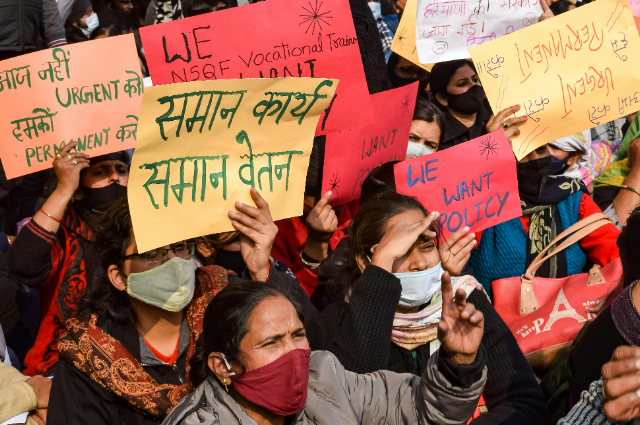
By Monday morning, Noida's Phase 2 and Sector 60, along with some sources, including Sector 62 and 63, had already crossed a point of no return. What began as a routine labour protest over the weekend escalated with startling speed into scenes of unrest that gripped the industrial belt with stones hurled at the cops, vehicles set ablaze, and thick plumes of smoke rising above one of the country’s busiest manufacturing zones. Police sirens cut through the chaos as tear gas filled the air, and at least 62 arrests followed in a matter of hours.
But this was not an overnight eruption. Beneath the violence lay a deeper story, notably mounting frustration among garment workers who had spent years navigating stagnant wages, exhausting shifts, and assurances that rarely materialised. By the time the first clashes broke out, the anger spilt beyond the factory walls, turning a protest into a confrontation the city could no longer ignore.
The Wage Gap at the Centre of it All
To understand why workers were on the streets in the first place, one must look at a earnings figure of “₹13,000”, the approximate minimum monthly wage a garment worker earns in Uttar Pradesh today, that has quietly become a source of rage and it is a pay total that looks increasingly indefensible when placed beside Haryana's newly revised minimum income line of ₹19,000 leaping from the previous ₹14,000, announced just weeks before these protests erupted. For Noida's garment export workers from economically vulnerable areas in eastern Uttar Pradesh and Bihar, this disparity means choosing between renting a room or cramming four to a floor, between sending money home or borrowing. The call for equal wages with Haryana is rooted in real-life experiences and hard numbers, thus bringing in tangible realities that people face every day, making a powerful case for fairness and parity. Clothing factory labourers are also pressing for fixed duty hours to replace the informal practice of open-ended shifts, mandatory overtime pay, salaries disbursed by the 10th of every month rather than delayed well into the following one, and the establishment of a credible, formal complaints mechanism, including a women-led committee to address workplace harassment.
How a Peaceful Protest became a Crisis?
The demonstrations began on April 10 (Friday) when thousands of garment workers from the Phase 2 Hosiery Complex launched a strike in what observers described as a largely peaceful show of numbers. By Sunday evening, however, it was clear that the energy on the ground was not dissipating. Authorities, concerned about escalating unrest, quickly brokered a resolution with relief measures including mandatory weekly offs, double wages for overtime and holidays, guaranteed monthly salaries by the 10th, annual bonuses before November 30, and a formal grievance committee. Furthermore, factory owners have been instructed not to terminate employees without notifying the district administration, with regular inspections planned to ensure compliance with labour regulations. The joint meeting took place at the Noida Authority office, involving district magistrate Medha Rupam, Authority CEO Krishna Karunesh, police commissioner Laxmi Singh, and senior labour officials, presenting the decisions with a substantial response on paper. Yet 13th April, 2026 (Monday) arrived with renewed fury, where the streets of Noida’s industrial belt witnessed scenes that seemed to belong to a different protest altogether, escalating the situation into vehicles ablaze, properties vandalised, stones arcing toward police lines. Several police personnel were injured, and authorities deployed tear gas to push back crowds that had grown in size and intensity rather than receded. The discrepancy between the declarations made on Sunday and the reality in the streets on Monday prompts a question that no formal communication adequately addresses: Even after assurance from the officials, why did the promises not succeed?
The Anatomy of a Trust Deficit
Part of the answer lies in institutional memory, in which garment workers in Noida have long faced unfulfilled promises from factory owners and officials regarding compliance with labor norms, with enforcement fading once attention shifts. Labour inspectors in Uttar Pradesh's industrial areas are chronically understaffed, and workers have inconsistent, unsafe options for escalating complaints. For instance, the National factory inspection rates have fallen from 47.56% in 2005 to 19.12% in 2023 under the Factories Act, leaving workers without reliable, fear-free channels to address issues, which worsens non-compliance. When Sunday's announcements were read against this backdrop, many workers did not see a resolution; they saw a script they had encountered before.
There is also the question of who made the announcements and on whose behalf. Workers who have long negotiated not with factory management but with layers of contractors and subcontractors often found that agreements made at the administrative level do not percolate down to the factory floor with any reliability. The Yogi government's decision to constitute a high-level committee to investigate root causes and recommend preventive measures signals at least a recognition that this cannot be treated as a one-off law-and-order incident, but the committee's credibility will depend entirely on whether its recommendations are time-bound and enforceable rather than archival.
A City Caught in the Crossfire
Beyond the industrial zones, the protests sent ripple effects across one of the region's busiest commuter corridors. The DND Flyway and the Chilla Border, which together handle tens of thousands of vehicles moving between Delhi, Noida, and Greater Noida each day, experienced heavy traffic jams as movement was disrupted and diversions were put in place near Sector 62's Fortis Hospital Road. Traffic toward the Chilla Border was rerouted via Char Kha Gol Chakkar and the DND Toll, adding significant time to commutes for workers, office staff, and logistics operators who had no stake in the dispute but bore its inconvenience regardless. In a region with tightly calibrated supply chains, even a single day of disruption can have widespread costs. The protests, while focused on garment workers' grievances, have broader implications for the entire industrial ecosystem that policymakers must address.
A Wider Reckoning
Noida's unrest does not exist in isolation, as all across the world, the compounding pressures of rising living costs, accelerated in part by fuel supply constraints linked to the ongoing US-Israel conflict with Iran, have strained working-class budgets in ways that governments have been slow to acknowledge and slower still to address. In this context, Haryana's decision to raise minimum wages by 35% within the past weeks was less an act of generosity than a recognition that the alternative sustained unrest carried greater political and economic risk. Uttar Pradesh now faces a comparable reckoning, and the high-level committee will need to move with urgency rather than deliberation if it hopes to prevent a recurrence.
Garment exports from the Noida belt run into thousands of crores annually, feeding global fashion supply chains that reach consumers in Europe, North America, and the Gulf. Workers in this trade leave home before dawn, operate machinery in poorly ventilated spaces, and return after dark, often lacking contracts, health coverage, or recourse for withheld wages or harassment. It is surprising that affluent people eventually took to the streets. The more difficult question, that will define whether Monday's violence becomes a turning point or a footnote, is whether the institutions responsible for governing this industrial corridor are genuinely prepared to answer it or not.
References
- https://www.hindustantimes.com
- https://www.ndtv.com
- https://timesofindia.indiatimes.com
- https://www.republicworld.com
- https://www.msn.com
- https://www.instagram.com
- https://www.instagram.com
- https://www.indiatoday.in
- https://timesofindia.indiatimes.com
- https://apparelresources.com
- https://www.instagram.com
- https://www.indiatoday.in
- https://www.indiatvnews.com
- https://www.hindustantimes.com
- https://economictimes.indiatimes.com
- https://www.republicworld.com
- https://reflections.live
- https://economictimes.indiatimes.com
- https://timesofindia.indiatimes.com